To construct records of collective memory, those grand collective narratives tend to cover a wide variety of media forms. They were always inclined to to those popular types, which in 1980s’ China were black-and-white newspaper and televisions of low image quality. In 1980s, televisions of first generations in China generated the collective memory of “neighborhood culture” and best wishes on their socialist future, which actually can never be represented by contemporary TVs at all.
Why are we going to review the spirit of Chinese women’s volleyball team from that era? Probably for the reason that Chinese people always hold the belief that memory and what is hidden behind will always trespass time and space. The values of those memories firstly lie in its records and reflections of their roots, always measuring the length of their history. Secondly, the meanings of identity, home, nation and volleyball spirit all strongly connect with each other, and without memory they become nothing but only some vague words. Chinese people understand, only combined with the context and oceans of multi-media materials, can those abstract words become a part of their national identity. The Chinese Volleyball Spirit became the flash point of a generation’s memory when the Chinese women’s volleyball team won the three successive world championships in the 1980s.
The History of Chinese Women’s Volleyball Team
The history of Chinese women’s volleyball team can trace back to the end of Qing Dynasty, around 1905. In the early days, volleyball in China was played by two teams of 9 players per side. In 1950s, Chinese volleyball changed into the international rules in which teams of 6 players compete in the game. In 1956, the women’s volleyball team took part in the second world championship held in France and won the sixth place. In the 1960s, the coach of the Japanese women’s volleyball team, known as the “東洋の魔女” (The Oriental Witches), Daimatsu Hirobumi, accepted the invitation of Premier Zhou Enlai for a one-month visit and helped the Chinese women’s volleyball team establish a more systematic training program. In the 1960s, due to political turmoil, the team failed to participate in international competitions. The new Chinese women’s volleyball team was formed in 1976, and Yuan Weimin became the head coach, who led the team to 铁the first championship.
The championships and media representations
The miracle of the Chinese women’s volleyball team winning three consecutive championships in the 1980s is still as new as ever, because that victory created a spiritual symbol called “the spirit of the Chinese women’s volleyball team”. On November 16, 1981, China won the world championship for the first time in the Third Women’s volleyball World Cup held in Japan. This is the first world champion of China in the Big Three, and the first world championship of the Chinese women’s volleyball team.
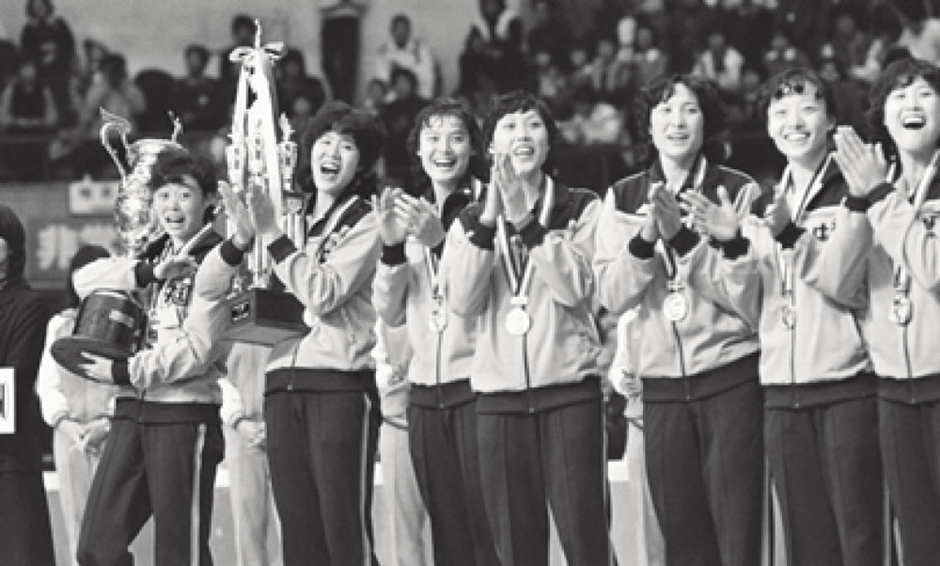
“At that time, few families had a TV. The administration department I worked in Chengdu had a small 20-inch TV…… We moved it to the yard, then placed those chairs and tables and pushed the TV to the top. The neighbors hushed to take a seat around to watch the game.” Cao Ning, a journalist of railway company recalled that moment, “I would say around 100 were there.” (Xu, 2019)
1, Movie
Similar view was represented in a segment from My People, My Country, a Chinese seven-part anthology drama film commemorating the 70th anniversary of PRC. In the part The Champion, historic moment when Chinese women’s volleyball team won the first Olympic champion is remembered by a comedy story happened on a Shanghai boy and his neighborhood. In order to maintain the stable signal of an old cable TV, he struggled to support the TV antenna and the moment when the volleyball team won.

Although it is a first-person narration story, the memory reflected in the film is an undeniable collective memory, a collective reflection that belongs to the “neighborhood culture” that flourished in the 1980s. Where there is a television set, it is the intersection of the national sport glory and the daily life of the people. The world was too big for the Chinese, who had just embraced Reform and Opening-up policy in the 1980s. This is a kind of memory link in a specific cultural environment, forming daily life as a unit of each neighborhood in the radiation of the geographical connections, while larger narratives like the women’s volleyball championship and the spirit of women’s volleyball are conveyed to every corner of urban and rural areas through the popular media. In the past, it was a black-and-white TV, a newspaper in its heyday, but now it is the movie that people flock to on National Day, as well as the interactive cultural perception on the Internet and streaming media.
2, Newspaper
Meanwhile, officials talked to the public through the Volleyball Spirit to create a collective memory that belongs to the whole nation. Almost all the newspapers in the country headlined the victory of the women’s volleyball team. On November 17, 1981, the People’s Daily, China’s most official communist party newspaper, ran a cover story titled “learning women’s volleyball, rejuvenating China”, a full-page compliment of the achievements of the Chinese women’s volleyball team.

On the same day, Deng Yingchao, a communist leader, published an article on “all walks of life should learn the spirit of women’s volleyball” in the Sports Daily, which established the position of the notion “spirit of women’s volleyball” in the propaganda discourse (CCTV Chinese International, 2019). In the official media, the Volleyball Spirit is defined as the spirit of “being down-to-earth, working hard, setting up lofty ideals and winning glory for the country”. This spirit is often represented to be associated with ‘socialist construction’, ‘the near victory of collectivism’, ‘dedication to the country’ and other political ideals, which finally become a very politicized notion.
‘National Memory’: 20191127 Chinese women volleyball: Unite and Struggle. CCTV Chinese International.
The Volleyball Spirit: a periodized memory
Such collective memory is periodized for the masses, and that is why it is described so unique and prominent. Winning a championship can be a fortuitous event, and it was constructed into a mythical collective memory and a representative event of the “new” era. The Volleyball Spirit represents a struggling spirit of the ‘reform and opening-up’ period. People then need to overcome the vast and hazy when their country is newly open to the world. Thus, this spirit is periodized and made for that particular period. After experiencing the political disaster, the volleyball team was reborn; its image has also been supplemented to become a spiritual force adapted to the development of socialism, instead of the original pure sports will. The spirit no longer treats the women’s volleyball players only as athletes, but also as national heroes and role models of The Times. No matter what, China at that time did need the Volleyball Spirit. It is a mixed memory for neighborhood and the nation — it is mediated for public and political needs.
Reference List
Chen Kaige. “My Country, My People: PV4 ‘The Champion’.” BiliBili, uploaded by BiliBili official, 30 Sept. 2019,
“Chinese women volleyball team won the first world champion.” People’s Daily, 17 Nov. 1981, p. 1.
“Film My Country, My People ‘The Champion’ PV”. YouTube, uploaded by Chin TV, 26 August 2019, https://www.youtube.com/watch?v=bWjk7uFEYk4.
My Country, My People. Directed by Chen Kaige, Huaxia Film Distribution Company, 2019.
“‘National Memory’: 20191127 Unite and Struggle”. YouTube, uploaded by CCTV Chinese International, 1 December 2019, https://www.youtube.com/watch?v=J5vn0WAvtJc&t=1416s.
Xinhua News. “Chinese women volleyball team won the first world champion.” Xinhua Net, 1981, http://www.xinhuanet.com/2019-09/22/c_1125024622.htm.
Xu, Zhouchao. “The spirit of women’s volleyball is a banner of passion years.” Xinhua Net, http://www.xinhuanet.com/2019-09/22/c_1125024622.htm. Accessed 22 Sept. 2019.
 Alice Memory